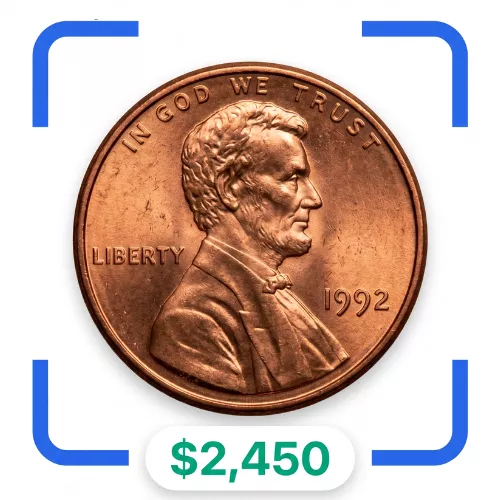


The Lincoln cent first appeared in 1909 to honor Abraham Lincoln on his centennial birthday.
The United States Mint in Philadelphia struck this piece as part of that historic debut.
Sculptor Victor David Brenner designed the new penny to replace the older Indian Head design.
He placed his initials on the reverse side at the bottom rim.
Many people felt the letters were too large and drew too much attention.
Public outcry quickly pushed the Mint to stop production and remove the initials.
Before the design changed, the Mint produced only a tiny batch of special proof strikes for collectors.
A single specimen of this rare penny sold for $258,500 at Heritage Auctions in 2014.
Professional coin graders certified the piece at PR-67+ Red-Brown.
The proof grade means the Mint struck it using polished dies and specially prepared planchets.
A number grade of 67+ indicates near perfection with virtually no marks or surface flaws.
The Red-Brown label means the original copper color has mellowed into a warm mix of original red and natural brown tone.
A certified grade guarantees authenticity and protects buyers when high-value coins change hands.
You should know that standard pocket change will never reach this level of value.
Only the absolute finest certified survivors command six-figure prices at major auctions.
The Mint struck only 1,194 proof cents with the VDB initials before halting production.
That low original output makes it one of the rarest regular proof issues in the entire Lincoln series.
Far fewer examples survived the decades in pristine condition.
This particular coin is widely considered the finest known example among all survivors, regardless of color designation.
Collectors love the drama behind the controversial initials and the sudden design change.
Strong collector demand for key date Lincoln cents always keeps prices high for top-tier specimens.
When the single best example of a legendary rarity crosses the auction block, serious bidders push the price to record levels.
Start by checking the date on the front of the coin under good light.
Look for the 1909 date below Lincoln's bust with no mint mark underneath it.
Flip the coin over to inspect the reverse side near the bottom rim.
Use a magnifying glass to look for the tiny letters V.D.B. centered between the tips of the two wheat stalks.
Check the surface texture next.
A real proof cent has sharp, squared rims and mirror-like fields rather than the standard matte finish of regular strikes.
Many people confuse ordinary worn 1909 VDB pennies from circulation with these rare proof issues.
Standard business strikes lack the mirror fields and sharp edges found on genuine proofs.
If you want a quick first check, you can scan the coin with CoinKnow or Coin Value Checker on your phone to see what you might have.
Any suspected 1909 VDB proof always requires professional third-party grading to confirm its status.
If charts make your eyes glaze over, which free coin identifier apps is worth installing is friendlier.
Upload a photo and get an instant value, grade estimate, and error check — no jargon, no sign-up required.