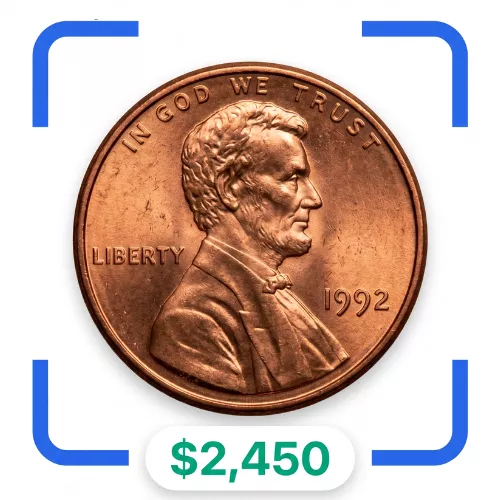


The Philadelphia Mint struck this special Lincoln cent in 1910.
It represents the second year the Mint ever produced Lincoln pennies in proof format.
Unlike modern shiny proofs, early Lincoln proofs were made using a special sandblast technique.
This process created a grainy, non-reflective surface known today as a matte proof.
The United States Mint struck these pieces in Philadelphia, so they carry no mint mark beneath the date.
Finding an early copper coin that kept its original bright red metal color is very unusual.
Most copper coins from this era oxidized over the decades and turned brown.
A top-tier example of this coin brought a massive $52,875 at Heritage Auctions.
Professional coin graders certified the piece in a Proof Red grade.
The proof designation confirms the coin was specially struck for collectors on prepared blanks.
The red designation means the copper retains almost all of its original mint luster and color.
Coins of this quality rarely appear on the open market.
Serious collectors will pay huge sums when an elite, certified piece finally goes up for bids.
An auction price like this belongs only to the finest known certified examples.
Matte proof Lincoln cents were not popular with the public when the Mint first made them.
Collectors at the time preferred mirror-like proof finishes and found the matte surface dull.
Because demand was low, the Mint produced very few proof pennies in 1910.
Many of the coins that did sell ended up spent as regular pocket change over time.
Raw copper is very sensitive to moisture, air, and improper paper holders.
As a result, only a tiny fraction of these coins survived without spotting, fading, or turning dark brown.
A 1910 matte proof with full, original red color is one of the biggest condition rarities in the entire series.
Lincoln cent specialists compete aggressively whenever one of these pristine red specimens becomes available.
Start by checking the date on the front of the coin to confirm it reads 1910.
Look below the date to make sure there is no mint mark, indicating it was made in Philadelphia.
Use a magnifying glass with at least 5x power to examine the surface texture closely.
A matte proof does not look like a mirror.
Instead, the fields have a distinct granular texture that looks almost like fine sandpaper.
Look at the rims of the coin to see if they are squared-off and very sharp.
Matte proofs received extra pressure from the dies, creating razor-sharp design details and wide, flat rims.
Check the color to see if it shows the bright orange-red glow of fresh copper rather than brown or red-brown toning.
People often confuse well-struck regular business strikes with true matte proofs.
You can use an app like CoinKnow or Coin Value Checker to get a quick first opinion on what you have.
If the coin shows the correct sharp features and granular surface, you should submit it to a major third-party grading service for authentication.
If you would rather point a camera than read a table, check which free coin identifier apps is worth installing.
Upload a photo and get an instant value, grade estimate, and error check — no jargon, no sign-up required.