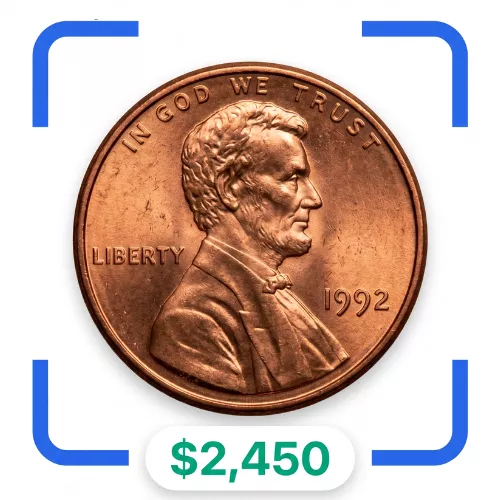


The Philadelphia Mint struck this special Lincoln penny back in 1912.
Most pennies made for daily spending have a shiny or standard business strike surface.
The United States Mint did something different for collectors during this era.
They produced what numismatists call a matte proof.
These coins were made using sandblasted dies to create a soft, granular texture across the entire surface.
Because it was struck in Philadelphia, the coin carries no mint mark below the date.
Copper coins from this period easily tarnished or darkened over time.
Finding an original proof from 1912 that kept its original red color is exceptionally difficult.
A top-tier example of this penny crossed the auction block at Heritage Auctions.
The winning bidder paid $37,600 to take it home.
Professional coin graders certified the piece in Proof Red condition.
The Proof designation means the coin was specially prepared and struck with high pressure for collectors.
The Red label, often shortened to RD, means the coin still shows at least 95 percent of its original bright mint luster.
Heritage Auctions handled the sale of this particular record-setting piece.
Certified proof coins in this state bring high prices because very few avoided air exposure and handling.
A price like this belongs to an elite, certified example rather than a typical pocket change find.
The 1912 matte proof in full red owes its value to extreme condition rarity.
Matte proof pennies were not popular with the general public when the Mint first sold them.
Many contemporary collectors thought the granular finish looked dull compared to older mirror proofs.
Because demand was low, many unsold pieces were simply melted or spent as regular money.
The collectors who did buy them often stored them in cardboard boxes or paper envelopes.
Old storage materials contained sulfur that turned the bright copper brown or spotted over the decades.
As a result, only a tiny handful survived with their original fiery red surfaces intact.
Specialist collectors compete aggressively whenever a genuine full-red example appears on the market.
You can check your coin at home by following a few simple visual steps.
Start by looking at the date on the front right side to confirm it reads 1912.
Look beneath the date to make sure there is no mint mark.
Grab a magnifying glass with at least 5x magnification to inspect the fields.
A genuine matte proof does not look like a modern mirror proof.
Instead, the background fields should show a microscopic, grainy texture resembling fine sandpaper.
The edges of the coin should be very sharp and squared off rather than rounded.
The rim should also show crisp, well-defined outer borders from the heavy striking pressure.
Check the overall color under a good desk lamp to see if it shows full copper red without heavy brown toning.
A standard 1912 penny from everyday change is often confused with a proof if it simply looks clean.
If you want a quick starting point, a mobile tool like CoinKnow can help you examine the basics before you seek a professional opinion.
Always remember that an official grade from a recognized grading service is required to confirm a true matte proof.
The low-effort option is a scanning tool — see the free coin identifier apps tools we tested side by side.
Upload a photo and get an instant value, grade estimate, and error check — no jargon, no sign-up required.