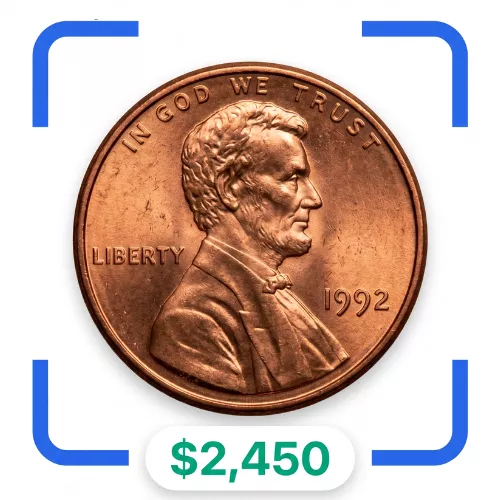


The United States Mint struck this Lincoln Cent in 1913.
Workers made these coins at the main mint facility in Philadelphia.
Because it came from Philadelphia, the coin carries no mint mark below the date.
Victor David Brenner designed the Lincoln penny just a few years earlier in 1909.
His portrait of Abraham Lincoln on the front and two wheat stalks on the back defined the series.
The mint made these cents out of a bronze alloy that turns brown as it meets the air.
Finding an early bronze penny that still looks bright red is quite uncommon.
A top-graded example of this coin brought $47,150 at auction.
Heritage Auctions handled the sale of this piece.
Professional coin graders certified the penny in Mint State Red condition.
Mint State means the coin never circulated in daily commerce and shows no trace of wear.
The Red designation means the copper kept almost all of its original bright mint luster.
Most copper coins from this era toned down to brown or red-brown over the decades.
Serious collectors will pay heavy premiums when a coin keeps that original fiery color.
Keep in mind that your everyday pocket change will not reach this price level.
Only the absolute finest certified pieces set records like this one.
The main driver behind this price is condition rarity.
Philadelphia struck millions of pennies in 1913, so the date itself is not rare in worn condition.
People spent almost all of them on newspapers, candy, and streetcar fares.
Very few people thought to set aside fresh rolls of cents in the early 1900s.
Copper reacts quickly to moisture, touch, and air pollution.
Over more than a century, most surviving 1913 pennies turned dark brown.
A Philadelphia 1913 in full-red condition is a true survivor from a bygone era.
Lincoln cent enthusiasts compete aggressively to own the highest-graded red example for their registry sets.
When two or more dedicated collectors want the same pristine coin, the bidding shoots up.
You can identify this coin by checking a few clear details on the front.
First, look at the date on the right side of Lincoln's chest to confirm it reads 1913.
Next, check the empty space directly beneath the date.
There should be no mint mark letter at all, which confirms it was made in Philadelphia.
If you see a small D or S, you are holding a branch mint coin instead.
Examine the overall surface color under good natural lighting.
A coin that qualifies for the Red label must display glowing orange-red copper surfaces across the entire face.
Do not confuse a genuinely pristine coin with one that someone cleaned or chemically stripped to look bright.
Cleaned coins have an unnatural, washed-out shine and fine hairline scratches under magnification.
A 5x or 10x jeweler's loupe will help you inspect the fields for any tiny spots or rubs.
If you are not sure what you have, a mobile tool like Coin Value Checker can provide a quick first pass.
After that initial check, you should show any promising piece to an experienced dealer for in-person review.
Want a value without learning grading terms first? See this comparison of every free coin identifier apps worth trying.
Upload a photo and get an instant value, grade estimate, and error check — no jargon, no sign-up required.