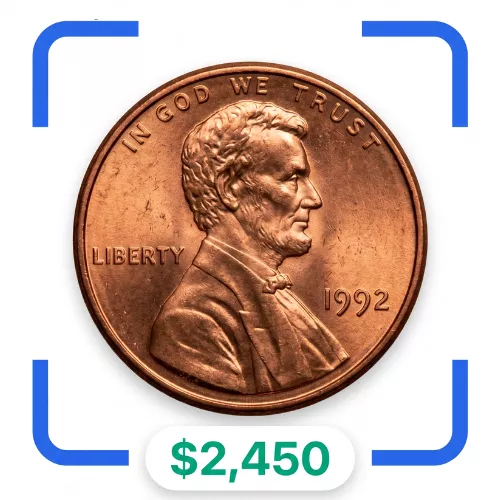


The San Francisco Mint struck this Lincoln cent back in 1913.
It belongs to the early years of the long-running Lincoln penny series.
Early branch mint cents from the 1910s are famous among collectors today.
Most of these pennies entered daily commerce right away and wore down quickly.
Finding an early San Francisco issue that never circulated is very difficult.
Finding one that kept its original bright red copper color is even harder.
Copper reacts with air and moisture over time, turning brown or red-brown.
That natural chemical change makes a fully red 1913-S penny a true standout in American numismatics.
A top-tier example of this coin brought $63,250 at Heritage Auctions.
Professional coin graders certified the coin in Mint State with a full Red designation.
Mint State means the penny has zero trace of wear from circulation.
Every tiny design line from the dies remains sharp and intact.
The Red label means the surfaces retain nearly all their original fiery mint luster.
Major auction houses handle millions of old pennies, but pieces in this preservation tier rarely appear.
Serious collectors competed aggressively when this piece crossed the auction block.
Bidders paid that five-figure sum because coins of this quality almost never come up for public sale.
The main reason behind this price tag is extreme condition rarity.
An early San Francisco issue in full red is a genuine rarity in every sense.
People in 1913 did not routinely save rolls of newly minted pennies as investments.
The few coins that people did tuck away often sat in humid drawers or paper envelopes.
Those storage methods caused the delicate copper surfaces to tarnish over the decades.
Most surviving 1913-S pennies are heavily worn and dark brown.
A small number survive in red-brown condition with partial luster.
A fully red specimen with no spots or marks sits at the very top of collector demand.
Many set builders need a high-grade red coin to finish an elite Lincoln cent collection.
When high demand meets an almost nonexistent supply, prices rise dramatically.
You can start checking your coin with a basic magnifying glass or a 10x jeweler loupe.
First, look at the front of the coin directly below the 1913 date.
You need to locate a small "S" mint mark stamped under the numerals.
If there is no letter below the date, the Philadelphia Mint made your penny.
A 1913 penny with no mint mark is far more common and carries much less value.
Next, inspect the surface color under strong, natural lighting.
A standard old penny will look chocolate brown or dull tan.
A true Red coin shows the bright, shiny orange-red glow of fresh copper.
Be careful not to confuse a genuine mint-state coin with a cleaned or polished piece.
Cleaned coins have an unnatural pink or hazy shine and show fine hairline scratches.
If you want a quick starting point, a mobile tool like Coin Value Checker can help you examine the date and mint mark placement.
Keep in mind that typical pocket change finds will not sell for thousands of dollars.
Only certified, perfectly preserved original coins can command record-breaking prices at auction.
The practical choice for a full jar is which free coin identifier apps is worth installing.
Upload a photo and get an instant value, grade estimate, and error check — no jargon, no sign-up required.