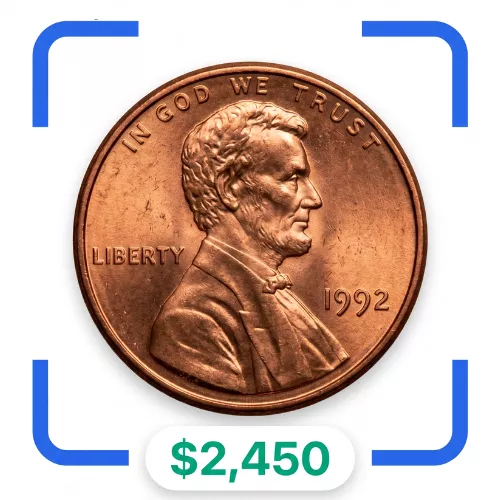


The 1914-D Lincoln cent is a standout piece in the Wheat penny series.
The Denver Mint struck these copper coins in 1914 with a distinct small "D" below the date.
While the Philadelphia Mint produced millions of pennies that year, Denver turned out only a tiny fraction of that total.
Today, collectors consider this specific issue the undisputed key date among all regular-issue Lincoln cents.
The abbreviation "RD" stands for Red, meaning the coin retains its bright, original copper luster from the day it left the dies.
Finding an early copper penny that never lost its fiery red color is extremely difficult.
In 2018, Legend Rare Coin Auctions handled the sale of an exceptional 1914-D cent.
The coin sold for a record-breaking $158,625.
The coin carried a certified grade of MS-66+ Red.
The "MS" means Mint State, indicating that the coin never circulated in daily commerce.
The grade 66+ on a 70-point scale shows that the surfaces have almost no marks, scratches, or wear.
The "Red" designation confirms that full original copper color covers nearly the entire surface.
When an issue this famous appears in nearly perfect condition, advanced collectors compete aggressively to own it.
The primary reason for the high value is the tiny original production run.
The Denver Mint made only 1,193,000 Lincoln cents in 1914.
By comparison, Philadelphia struck over 75 million pennies during that exact same year.
People in 1914 did not save new pennies in large quantities, especially out in the western states.
Almost all of these coins entered everyday cash registers and pockets, wearing down through decades of use.
Most survivors that exist today show heavy signs of wear, smooth details, and dark brown surfaces.
Genuine Mint State survivors are extraordinarily scarce.
Even low-grade examples with honest wear routinely sell for $175 or more if they are problem-free.
You can identify this coin by looking at the obverse side showing Abraham Lincoln.
Check the date on the right side of the coin to confirm it reads "1914".
Look directly below the date for the small "D" mint mark.
Use a 5x or 10x jeweler loupe to examine the mint mark under good light.
Be very careful, because this issue is frequently targeted by counterfeiters.
A common trick involves taking a cheap 1914 penny from Philadelphia and soldering a fake "D" onto the surface.
Another common fake involves altering the date on a 1944-D penny by shaving away part of the first "4".
If you want a fast preliminary check, you can scan the coin with CoinKnow or Coin Value Checker on your phone.
Because so many altered coins exist, professional third-party authentication is completely non-negotiable for this date.
Keep in mind that heavily worn coins are the norm, and six-figure prices belong only to top-tier Mint State pieces.
Do not feel like identifying it yourself? the free coin identifier apps tools we tested side by side will.
Upload a photo and get an instant value, grade estimate, and error check — no jargon, no sign-up required.