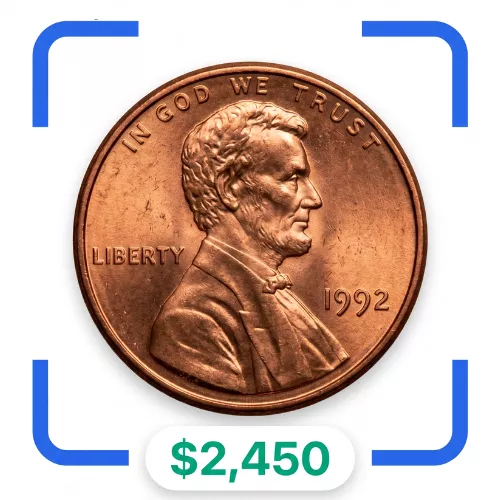


The San Francisco Mint struck this Lincoln Cent back in 1918.
World War I was ending that year, and the United States needed a massive supply of small change.
San Francisco produced millions of these bronze pennies to keep up with daily business needs.
Most of them went straight into pocket change and saw heavy use across the western states.
Finding an ordinary circulated 1918-S penny is not hard for most collectors.
Finding one that survived in pristine, original condition is an entirely different challenge.
This particular coin holds rank 48 on the list of the top 200 most valuable pennies.
A premier example of this coin brought a winning bid of $37,950.
Heritage Auctions handled the sale of this rare piece.
The coin was certified in Mint State Red condition, often shortened to MS Red.
Mint State means the penny never saw any circulation wear after leaving the dies.
The Red designation means the copper metal still shows its bright, original mint luster.
Copper naturally oxidizes and turns brown over time, so original red surfaces are tough to find on early wheat pennies.
That high price reflects what serious collectors pay when a top-tier certified survivor crosses the auction block.
Your typical pocket change find will not bring this kind of money.
The key driver behind this high value is condition rarity.
San Francisco had a reputation for weak strikes and softer die details during this era.
Collectors in 1918 rarely saved whole rolls of new pennies directly from the San Francisco Mint.
Most 1918-S pennies quickly turned brown or wore down through daily spending.
A full-red surface on a century-old copper coin requires nearly perfect storage conditions.
Moisture, air, and paper envelopes often cause old copper to tone dark brown or develop spots.
Because so few full-red pieces exist, Lincoln Cent specialists compete fiercely whenever one appears.
That intense demand from registry set builders pushes auction prices to record levels.
You can check your own coin by looking closely at a few specific areas.
First, look at the front of the coin under a good light source and use a 5x or 10x magnifying glass.
Find the date 1918 on the right side of Abraham Lincoln's portrait.
Look directly below the date for the small "S" mint mark.
If there is no letter below the date, the penny was made in Philadelphia instead.
If you see a "D" under the date, it came from the Denver Mint.
Next, examine the color of the copper across both sides of the coin.
To qualify for top value, the coin must show original, bright orange-red luster rather than dark brown or faded red-brown tones.
Check the coin for any signs of artificial cleaning, which can make a penny look shiny but ruins its real numismatic value.
If you are not sure what you have, a mobile tool like CoinKnow or Coin Value Checker can give you a helpful first look.
Always remember that only professional grading services can officially verify a Mint State Red grade.
Want the value without the research? Start with the free coin identifier apps picks that held up in testing.
Upload a photo and get an instant value, grade estimate, and error check — no jargon, no sign-up required.