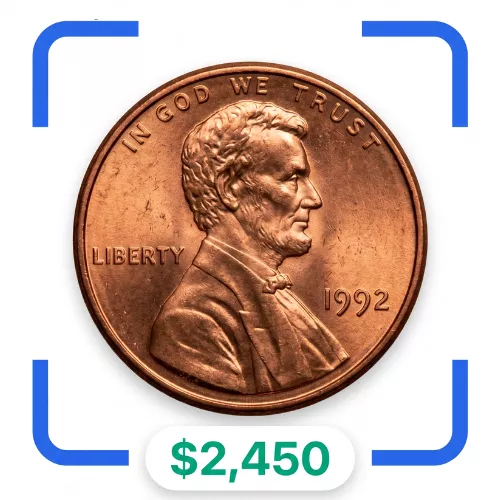


The Lincoln Cent series has a lot of famous dates, but the 1922 issue is unique.
In 1922, the Denver Mint was the only branch of the United States Mint making pennies.
The Philadelphia Mint did not strike any cents at all that year.
Because the Denver facility had to handle the entire production run, workers used their coin dies until they wore down heavily.
One pair of dies wore down so badly that the "D" mint mark stopped showing up on the struck coins.
This created a coin with no visible mint mark, making it look like a regular Philadelphia issue even though Philadelphia never made any.
It ranks at number 17 out of the top 200 most valuable coins on our list.
Top examples of this rare variety bring huge prices on the auction block.
One exceptional piece sold through Heritage Auctions for a massive record price of $92,000.
The coin was certified in Mint State condition with a Red-Brown surface designation.
A Mint State grade means the penny never saw actual spending use and shows no wear on its highest details.
The Red-Brown label means the original bright copper color has aged naturally into a mix of reddish tones and chocolate brown patina.
Coins kept in uncirculated condition for over a century are hard to find, which is why certified examples bring such large sums.
Record prices like this belong only to top-tier certified specimens, not regular pocket change finds.
Not all 1922 cents without a mint mark are created equal.
Numismatists separate these coins into different die pairs based on how the strike looks.
The most desirable and valuable version is known as the Strong Reverse variety.
On this specific variety, the front of the coin lacks the "D" mint mark due to die polishing and wear.
However, the back of the coin was struck with a much fresher die, leaving crisp lines on the wheat stalks and lettering.
The sharp contrast between a missing mint mark on the front and strong detail on the back makes it a true collector favorite.
Most examples discovered over the decades are heavily worn from years in cash registers.
Finding a Strong Reverse piece that survived in Mint State condition with original color is extremely rare.
High demand from Lincoln penny specialists keeps the market price for these pieces very strong.
If you have a 1922 penny, you can inspect it at home to see what you have.
Start by looking directly below the 1922 date with a good magnifying glass under a bright desk lamp.
You should see no trace of a "D" mint mark beneath the numerals.
Next, flip the penny over to look at the reverse design.
Check the two wheat ears and the words "ONE CENT" and "E PLURIBUS UNUM" to see if the letters look bold and crisp.
The Strong Reverse variety must have sharp reverse lines, unlike the much weaker Die 2 varieties that have blurry details on both sides.
If you want a fast second opinion on the details, you can scan the piece with CoinKnow or the Coin Value Checker app to get a baseline read.
Remember that fakes exist and faint mint marks are easily misidentified by the naked eye.
You will need a professional grading service to examine the coin under a microscope to confirm the exact variety attribution.
Want to avoid a trip to the coin shop? our breakdown of each free coin identifier apps we tried covers the basics.
Upload a photo and get an instant value, grade estimate, and error check — no jargon, no sign-up required.