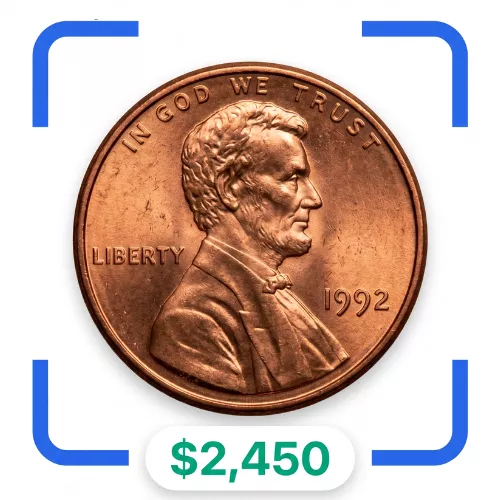


The Philadelphia Mint struck millions of regular Lincoln cents in 1936.
A few of those pennies came from a die that received an offset impression during production.
This mistake created a classic doubled die obverse variety.
Collectors refer to this specific variety as FS-101 in the Cherrypickers Guide.
It is one of three recognized doubled die varieties for the 1936 Lincoln cent.
The coin was made with standard bronze alloy and shows a bright red color when fully preserved.
Most 1936 cents trade for pocket change, but this specific doubled die is a major rarity.
A top-grade example of the 1936 FS-101 cent sold for $48,000.
Heritage Auctions handled the sale of this record-setting penny.
The coin was certified in Mint State Red condition.
A Mint State Red grade means the copper coin never circulated and kept its original fiery copper luster.
Copper tends to turn brown as it reacts with air over the decades.
Finding a vintage error coin with full red surfaces is exceptionally hard.
Top-tier collectors competed heavily to own one of the finest known specimens.
You should keep in mind that ordinary or worn examples will not bring this price level.
Condition rarity is the biggest factor behind the high sale prices.
Few people saved brand-new error coins during the Great Depression era.
Most of these pennies entered daily commerce and suffered years of wear.
Over time, the exposed copper turned dark brown or acquired scratches.
The variety itself also enjoys strong demand because of its inclusion in major reference guides.
Lincoln cent enthusiasts try to collect every major doubled die in the series.
The FS-101 is the most famous and dramatic of the 1936 varieties.
When high demand meets a tiny supply of uncirculated red pieces, prices jump quickly.
Start by checking the front of your 1936 penny.
Make sure the coin has no mint mark below the date, which confirms it was struck in Philadelphia.
Grab a coin loupe or magnifying glass with at least 10x magnification.
Look closely at the motto IN GOD WE TRUST across the top edge.
You want to see distinct, raised secondary lettering along the primary letters.
Next, inspect the word LIBERTY on the left side of Lincoln.
The FS-101 variety shows clear shelf-like doubling across these letters.
Do not confuse true die doubling with machine doubling.
Machine doubling creates flat, shelf-like steps, while a doubled die shows raised, rounded letter shapes.
If you want a quick second opinion, snap a clear photo with Coin Value Checker to do a first pass on your coin.
A reputable grading service can then verify the variety under a microscope if the doubling looks correct.
If charts make your eyes glaze over, the free coin identifier apps tools we tested side by side is friendlier.
Upload a photo and get an instant value, grade estimate, and error check — no jargon, no sign-up required.