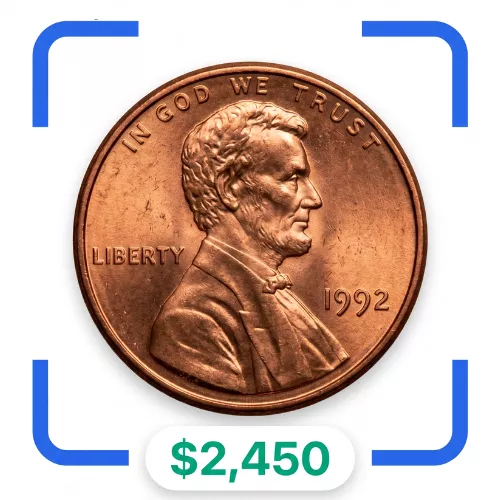


The 1937-S Lincoln cent is a classic copper penny struck at the San Francisco Mint.
During the late 1930s, the United States Mint produced millions of bronze cents across its branches.
San Francisco usually produced far fewer coins than Philadelphia or Denver.
Because of this, cents bearing the small "S" mint mark have always caught the attention of penny collectors.
Bronze coins from this era were made mostly of copper, which naturally darkens as it reacts with the air.
Finding an original 1937 San Francisco penny that never circulated is difficult on its own.
Finding one that still shows the bright copper color from the day it was made is much harder.
This particular coin sits at rank 46 on our list of the 200 most valuable pennies.
A top-quality example of the 1937-S penny sold for an impressive $38,400.
Heritage Auctions handled the sale of this standout coin.
The penny was certified as a Mint State Red example, often abbreviated as MS RD.
The "Red" designation means the coin retains at least 95 percent of its original bright copper color.
Grading services award this color label only when copper coins avoid the brown toning that naturally occurs over decades.
A price tag this high is set by an elite, top-tier coin rather than an ordinary pocket-change find.
Serious registry set collectors often bid aggressively when a coin of this quality appears at a major auction.
The main driver behind the $38,400 price is condition rarity.
A regular 1937-S penny from everyday circulation is common and only worth a modest amount.
However, an example in full-red condition is an entirely different story.
Copper is a very reactive metal that oxidizes quickly when handled or stored in humid environments.
Most 1937-S pennies turned brown or red-brown within a few years of release.
Very few coins were set aside immediately in protective holders to preserve their pristine surfaces.
When a coin survives for generations without heavy contact marks, spots, or tarnish, collectors will pay massive sums to own it.
The Lincoln cent series is also one of the most widely collected sets in American numismatics.
This strong collector demand creates fierce competition whenever a pristine Red specimen hits the auction block.
To inspect your coin, make sure you have good lighting and a simple magnifying glass.
Start by checking the date on the front right side of the coin, just below Lincoln's chest.
Look directly underneath the date for the "S" mint mark.
If there is no letter below the date, the penny was struck in Philadelphia.
If you see a "D", it was made in Denver.
Next, examine the color and surface quality of the metal.
To qualify as Red, the coin must show vivid, bright copper luster across both sides without dark brown spots.
You can use an app like Coin Value Checker to snap a quick photo and get a helpful first pass on your coin.
Look closely at Lincoln's cheek and the wheat ears on the back for any signs of friction or wear.
If the high points show dull gray or brown patches, the coin has circulated and will not reach record prices.
Only certified, uncirculated specimens with original color command five-figure sums at public auction.
A photo is usually faster than a chart — see the free coin identifier apps picks that held up in testing.
Upload a photo and get an instant value, grade estimate, and error check — no jargon, no sign-up required.