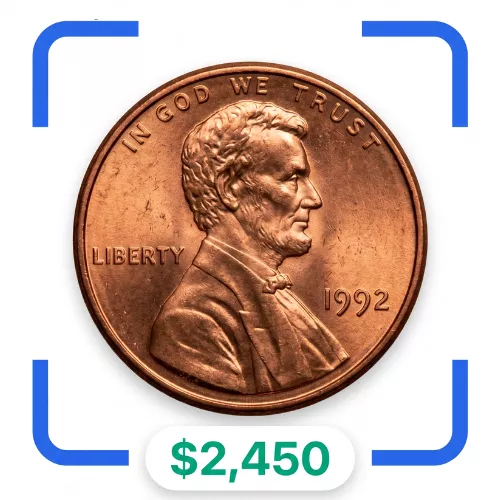


The Philadelphia Mint struck millions of Lincoln pennies in 1940.
World War II was already underway in Europe, but the United States had not yet entered the fight.
Because copper was not yet restricted for the war effort, these cents were made with the classic bronze alloy.
Lincoln cents struck at the main mint in Philadelphia carry no mint mark under the date.
Most of these pennies entered daily circulation right away.
People spent them on newspapers, candy, and bus rides throughout the 1940s.
Finding an ordinary 1940 penny in pocket change is still relatively easy today.
Finding one that looks like it left the dies five minutes ago is an entirely different challenge.
Heritage Auctions sold a top-tier 1940 Lincoln cent for a stunning $14,950.
The coin achieved a Mint State Red grade from professional graders.
The Mint State part of the grade means the coin has zero trace of wear from circulation.
Every tiny detail on Lincoln's hair, coat, and the wheat ears remains fully intact.
The Red designation means the coin retains at least 95 percent of its original mint luster.
Copper reacts quickly with oxygen, moisture, and skin oils over time.
Seeing an original bright orange-red surface survive intact for decades is remarkably rare.
Bidders competed intensely at Heritage Auctions because coins of this quality appear on the market very infrequently.
Keep in mind that this high price applies only to elite, certified specimens at the peak of the grading scale.
This coin is a classic example of what collectors call condition rarity.
The 1940 penny is not a rare date by mintage numbers.
What makes it rare is its flawless preservation over more than eight decades.
Raw copper is one of the most chemically active metals used in coinage.
Most old cents turn brown or develop spots within a few years of release.
Grading services separate copper coins into three color categories: Brown, Red-Brown, and Red.
Collectors who build high-end Lincoln sets demand coins with the full Red label.
Competition between registry set collectors drives prices higher whenever a pristine piece goes to auction.
A typical circulated 1940 penny might only be worth a few cents, while a perfect Red example commands thousands.
Look at the date on the front of the coin to confirm it reads 1940.
Check the space directly beneath the date.
A Philadelphia coin will have an empty space below the numbers, with no mint mark letter.
Inspect the color under a good desk lamp or natural indirect sunlight.
A valuable piece will show a bright, glowing copper-red finish rather than a dull brown or chocolate tone.
Use a 5x or 10x jeweler's loupe to scan the surfaces for contact marks or bag scratches.
Even tiny hairline scratches or dark carbon spots can prevent a coin from earning a top grade.
Make sure you do not confuse a cleaned or polished coin with an original mint-state surface.
Harshly cleaned copper looks unnaturally pink or washed out and loses its swirling mint luster.
If you want a fast way to evaluate your penny, a phone app like Coin Value Checker can give you a helpful first scan.
Remember that only independent grading by a major service can confirm whether a coin qualifies for a five-figure grade.
The simplest way to get a ballpark value is to photograph the coin — see which free coin identifier apps is worth installing.
Upload a photo and get an instant value, grade estimate, and error check — no jargon, no sign-up required.