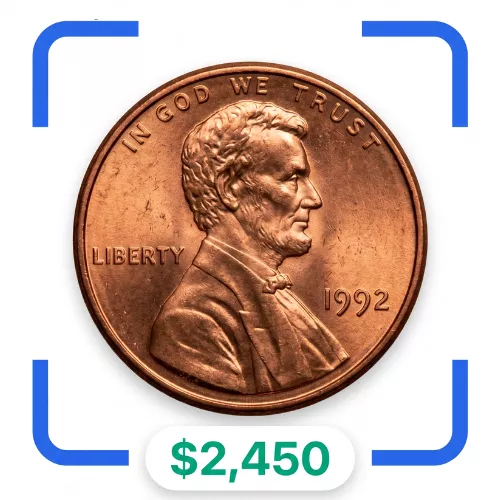


The United States Mint struck this special Lincoln penny in 1941.
All proof coins from this year were made at the Philadelphia Mint.
Because it was struck in Philadelphia, the coin carries no mint mark below the date.
Proof coins were not meant for daily pocket change.
Mint workers used polished dies and specially prepared bronze blanks to make them.
These pieces were sold directly to collectors who ordered them from the government.
This date holds a special spot in the Lincoln series because the United States entered World War II late in 1941.
The mint soon paused proof coin production to focus resources on the war effort.
That pause makes 1941 the final pre-war proof issue for Lincoln cents.
Top-quality examples of this penny can bring huge sums at public sales.
A stunning specimen reached a record price of $28,200 at Heritage Auctions.
Professional coin graders certified the piece in Proof Red condition.
The Red label, often shortened to RD, means the coin still shows its original bright copper color.
Copper naturally turns brown as it reacts with air over time.
Keeping a proof penny bright red for decades is very difficult.
That top-tier color combined with a flawless strike explains why serious bidders fought for this piece.
Most surviving examples do not come close to this level of preservation.
Several clear factors create the strong price tag for this penny.
The pre-war timing plays a big role in collector demand.
Collectors love owning the final proof issue struck before the wartime pause.
Condition rarity is the biggest price driver of all.
Many proof pennies from the 1940s were kept in paper envelopes that tarnished their surfaces.
Over the years, the bright orange-red luster faded into dull brown or spotted red-brown.
A 1941 mirror proof with pristine, full red color is genuinely tough to find.
Lincoln cent enthusiasts compete aggressively whenever an elite survivor appears on the market.
You can check your coin at home by looking for a few key details.
First, check the front of the penny for the 1941 date.
Make sure there is no small letter beneath the numbers.
Next, look closely at the flat background areas of the coin, which are called the fields.
A genuine proof penny has highly reflective, mirror-like fields.
The design elements, including Lincoln's portrait, will show sharp and squared-off edges.
Do not confuse a proof coin with a standard business strike that is simply shiny and uncirculated.
Standard coins have satiny or cartwheel luster rather than deep, glass-like reflection.
Look for bright, glowing copper color across both sides to see if it meets the full red standard.
If you are not sure what you have, you can use Coin Value Checker on your phone for a quick first look.
An app like that can help you decide if your piece is worth sending to a professional grading company.
Always hold your coin by the edges to protect the fragile surfaces from fingerprint damage.
Want a sanity check on your own read? a closer look at which free coin identifier apps actually works can confirm it.
Upload a photo and get an instant value, grade estimate, and error check — no jargon, no sign-up required.