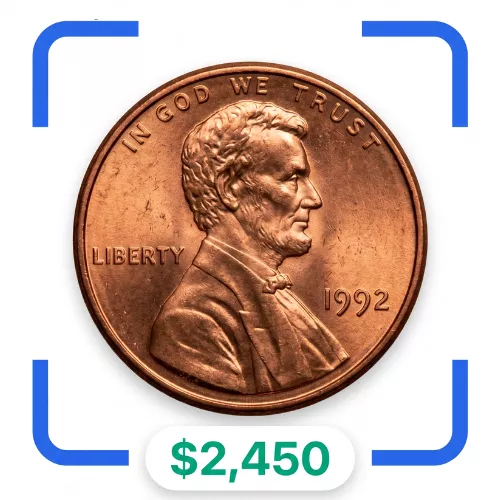


The Philadelphia Mint struck this special Lincoln Cent in 1942.
Proof coins are made with polished dies and polished blanks to create a mirror-like finish.
This was the final year the United States Mint produced proof sets before pausing production for World War II.
Resources and factory capacity had to shift entirely toward the war effort.
Proof coinage did not return until several years later.
That makes this issue the last classic proof cent of the early era.
Because it came from Philadelphia, the coin carries no mint mark below the date.
Heritage Auctions sold a top-tier example of this coin for $17,625.
The coin was certified in Proof Cameo condition.
A Cameo designation means there is a strong visual contrast between different parts of the coin.
The flat background shines like a clear mirror.
The raised design elements, like Abraham Lincoln's portrait, have a frosty, milky look.
This sharp contrast makes the details pop off the surface.
Proof cents from this era rarely received the Cameo label because the frosty effect wore off the dies very quickly.
Collectors will pay record prices whenever a certified Cameo piece crosses the auction block.
Most 1942 proof pennies have brilliant, shiny surfaces all over.
When the mint made proof dies back then, only the first few dozen coins struck had that heavy frost on the raised details.
As the dies struck more blanks, the frost faded away into a plain mirror finish.
Finding a genuine 1942 proof with true Cameo contrast is extremely difficult today.
Condition rarity is the main driver behind this five-figure price tag.
Many surviving 1942 proofs were mishandled over the decades.
Collectors often touched them with bare fingers or stored them in paper holders that caused dark spotting.
A clean, well-preserved piece with strong contrast sits at the very top of collector demand.
The fact that this was the last proof penny before the wartime pause adds extra historical appeal.
Start by checking the date on the front of the coin.
Look for the year 1942 under Lincoln's chest.
Make sure there is no mint mark letter beneath the date.
Next, examine the surfaces under a good light source using a 5x or 10x magnifying glass.
A proof coin will have square, sharp rims and extremely deep, reflective fields.
Do not confuse a regular business-strike penny with a proof.
Standard pennies made for pocket change can look shiny when new, but they lack the mirror-smooth background of a true proof.
Check the portrait of Lincoln and the wheat stalks on the back for a white, frosted texture.
You should see a clean break between the frosty portrait and the dark, watery background.
If you want a quick check before visiting a dealer, you can use an app like CoinKnow or Coin Value Checker on your phone to scan the details.
Keep in mind that typical pocket change finds will not be worth thousands of dollars.
Prices like this belong strictly to pristine, professionally certified Cameo proofs.
Want to skip the guesswork on a single coin? Try our breakdown of each free coin identifier apps we tried.
Upload a photo and get an instant value, grade estimate, and error check — no jargon, no sign-up required.