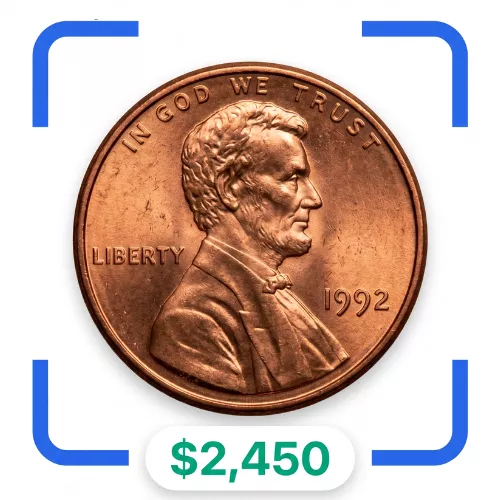


During World War II, the United States Mint changed how it made Lincoln cents.
Copper was needed for the war effort, so the Mint produced zinc-coated steel pennies in 1943.
By 1944, the Mint returned to using bronze for penny production.
A few leftover steel blanks from the previous year still remained in the supply hoppers.
Workers at the San Francisco facility fed those leftover metal disks into the coin presses by mistake.
Those stray blanks were struck with the new 1944 dies carrying the S mint mark.
That wartime error created one of the most famous transition mistakes in American coinage history.
Instead of a standard bronze cent, a tiny batch of silver-colored pennies slipped out the door.
A top-quality example of this coin brought $408,000 at a public sale.
Heritage Auctions handled the bidding for the piece in 2021.
Professional coin authenticators graded the penny at MS-66.
The letters MS stand for Mint State, which means the coin never circulated in daily commerce.
A grade of 66 on the 70-point scale shows that the piece has clean surfaces with very few marks or flaws.
Steel coins corrode easily, which makes finding one in near-perfect shape very unusual.
Buyers at this level pay high sums because the piece is fully authenticated and protected in a tamper-proof holder.
A verified grade gives serious collectors confidence before they bid massive amounts of money.
Rarity is the main reason this penny commands such high bids.
Researchers know of only two genuine 1944 steel cents from the San Francisco Mint.
The record-setting MS-66 example is the finest known 1944 steel cent from any United States mint facility.
Many collectors know about the famous 1943 bronze cent, but authentic 1944 steel cents are actually rarer.
Hardly any survive because the Mint never meant to strike them in the first place.
Lincoln cent collectors love error coins that mark major historical events like World War II.
With only two known to exist from San Francisco, demand will always outstrip supply.
Whenever one appears on the auction floor, advanced collectors compete aggressively to own it.
You can test a suspected steel cent using a few basic steps at home.
Look at the date on the front right side of the coin to confirm it clearly reads 1944.
Check right below the date for the small letter S mint mark.
Look closely at the metal color under a bright light.
A steel penny will show a silvery-gray surface rather than the typical reddish-brown tone of bronze.
Test the piece with a simple household magnet.
A real steel penny will stick firmly to a magnet, while regular bronze pennies will not react at all.
Place the coin on a precise digital scale to verify the weight.
A genuine wartime steel penny weighs 2.70 grams, which is lighter than a standard 3.11-gram bronze penny.
Watch out for altered dates and regular copper cents that someone plated with zinc or chrome to fool buyers.
If you want a fast preliminary check on an unfamiliar piece, you can use the CoinKnow or Coin Value Checker app on your smartphone.
Keep in mind that top auction records belong to verified museum-quality pieces, not typical pocket change.
If your coin passes the magnet and weight tests, send it to a major third-party grading service for full authentication.
If all you need is a rough range, the free coin identifier apps picks that held up in testing provides it fast.
Upload a photo and get an instant value, grade estimate, and error check — no jargon, no sign-up required.