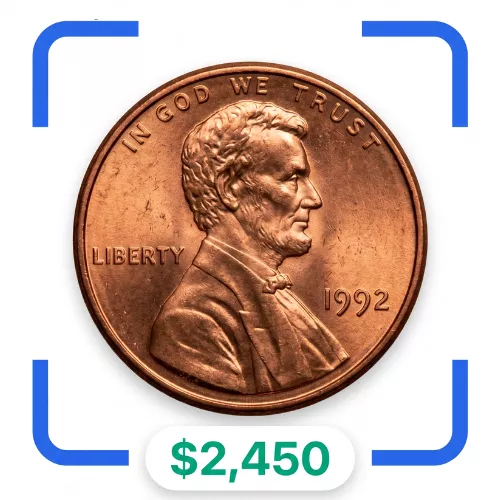


The Philadelphia Mint struck billions of Lincoln cents during World War II.
In 1943, the United States Mint switched from bronze to zinc-coated steel to save copper for the war effort.
The public disliked the steel cents because they looked too much like dimes and rusted easily.
The Mint switched back to a bronze alloy for pennies in 1944.
A few leftover steel planchets were accidentally fed into the coin presses at the Philadelphia Mint that year.
The result was the 1944 steel Lincoln cent, one of the most famous wartime errors in American numismatics.
Because the Philadelphia Mint did not use a mint mark at the time, these coins show only the date on the front.
These pieces look like normal 1943 pennies at first glance, but they carry the 1944 date.
In 2021, Heritage Auctions sold a 1944 steel cent for $180,000.
The coin was certified in MS-64 condition by a major grading service.
The MS-64 grade stands for Mint State 64, which means the coin is uncirculated.
A coin at this grade has never been spent in daily trade and still keeps its original mint luster.
It shows only minor contact marks or light spots from storage over the decades.
High-grade wartime steel coins are difficult to find because zinc coatings tend to spot or corrode over time.
Finding a steel error coin in this fresh, uncirculated condition is what drove the price to such a high level.
Top collectors compete fiercely whenever a certified example of this quality comes up for public sale.
The main driver of value is extreme scarcity.
Professional coin authenticators at PCGS estimate that only 25 to 30 examples of the 1944 Philadelphia steel cent exist.
That makes this coin more than twice as rare as the famous 1943 bronze cent.
Historians have a leading theory on how these rare errors happened.
During 1944, the Philadelphia Mint was also producing two-franc coins for Belgium on steel planchets.
A few of those foreign steel blanks likely got mixed into the hopper bins holding bronze cent blanks.
The stray blanks were struck by normal 1944 penny dies and released into circulation unnoticed.
Because so few survived, demand from advanced Lincoln cent collectors always exceeds the available supply.
You can test a potential 1944 steel cent using a few basic tools at home.
Start by looking closely at the date and mint mark area on the front of the coin.
A genuine Philadelphia issue will show the date 1944 with no letter below it.
The coin should have a dull silvery-gray color rather than the reddish-brown tone of bronze.
The simplest test is to touch the coin with a common household magnet.
A genuine steel penny will stick firmly to the magnet, while a standard bronze penny will not.
You can also weigh the coin on a precise digital scale.
A real steel cent weighs about 2.70 grams, while a standard 1944 bronze penny weighs about 3.11 grams.
Be careful of altered coins when you inspect the date under a magnifying glass.
Scammers often take a common 1943 steel cent and carve the last digit to look like a 4.
Other fakes are regular bronze 1944 pennies that someone coated with zinc, chrome, or silver paint.
Plated bronze coins look silvery, but they will fail the magnet test and weigh more than 2.70 grams.
If you are unsure about what you found in change, you can snap a photo with Coin Value Checker or CoinKnow for a quick initial review.
Any silvery 1944 penny that sticks to a magnet and weighs correctly should be sent to a major grading service for professional authentication.
The fast option is to scan and compare — see which free coin identifier apps is worth installing.
Upload a photo and get an instant value, grade estimate, and error check — no jargon, no sign-up required.