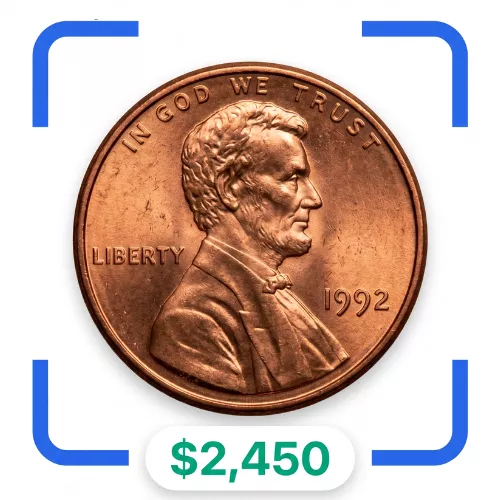


The 1950 proof Lincoln cent holds a special place in twentieth-century coin history.
The United States Mint struck these special collector coins in Philadelphia.
Because Philadelphia made them, the coins do not feature a mint mark below the date.
This release was a huge deal for collectors at the time.
The Mint had stopped making all proof sets in 1942 because of World War II metal shortages.
Production finally resumed in 1950 after an eight-year break.
Collectors were eager to buy these newly restored proof sets.
Most of the cents made that year came out with standard, shiny proof finishes.
Only a tiny fraction showed a stark, frosted design against deeply reflective fields.
These rare examples are known today as Deep Cameo proofs.
Top-tier examples of this post-war return can bring serious money at public auction.
One exceptional piece sold through Heritage Auctions for a massive price of $19,975.
Professional coin graders certified the coin as a genuine Proof DCAM specimen.
A Proof grade means the coin was specially struck on polished blanks with polished dies for collectors.
The DCAM designation stands for Deep Cameo.
This means the raised design elements have a thick, milky frost while the flat background acts like a black mirror.
Auction records like this happen when advanced collectors compete for condition perfection.
Regular pocket change will never reach this level.
Only a pristine, fully certified proof cent with extreme contrast can command this kind of payout.
Getting a heavy cameo effect on a 1950 proof penny was very difficult back then.
The Mint prepared proof dies using special acid-etching techniques to create the frost.
This frosty texture wore away quickly as the dies struck metal blanks.
Only the first few dozen coins struck with freshly treated dies received the full Deep Cameo contrast.
Once the frost smoothed out, the rest of the coins looked like standard, brilliant proofs.
Because 1950 was the first year back after the wartime pause, Mint workers were still refining their methods.
Finding a 1950 proof with true Deep Cameo surfaces is far harder than finding one from later in the decade.
Lincoln cent enthusiasts actively hunt for these early strikes to complete high-end registry sets.
High demand paired with very low survival rates drives the price up to record heights.
Telling a standard coin from a true Deep Cameo proof takes careful looking.
Start by checking the date on the front right side for the year 1950.
Look directly under the date to confirm there is no mint mark.
Hold the coin under a single light source and tilt it gently from side to side.
You can use a simple 5x or 10x magnifying glass to inspect the finer details.
Look closely at the portrait of Abraham Lincoln and the wheat stalks on the back.
A standard uncirculated coin is simply bright and uniform all over.
A true DCAM proof shows a stark, frosty white texture on Lincoln's bust.
The flat fields behind him must look like dark, crystal-clear mirrors with no haze.
If you want a fast second opinion on what you have, mobile tools can help.
You can use Coin Value Checker to scan your coin and get a helpful starting point.
Remember that worn pocket change cannot become a proof coin.
If you suspect you have a genuine Deep Cameo specimen, send it to a major third-party grading service for authentication.
The practical choice for a full jar is this comparison of every free coin identifier apps worth trying.
Upload a photo and get an instant value, grade estimate, and error check — no jargon, no sign-up required.