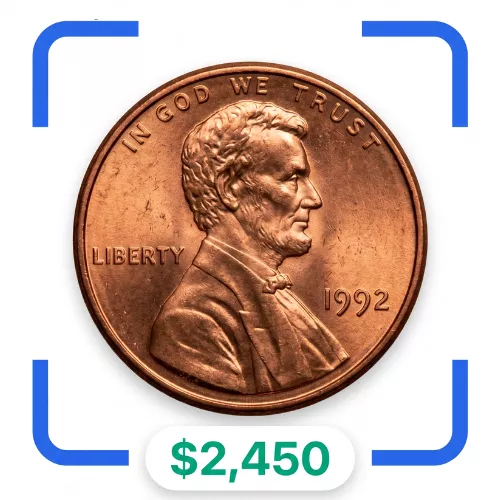


The Philadelphia Mint struck special proof Lincoln cents for collectors in 1951.
These pennies did not enter regular circulation.
Mint workers polished the dies and blanks to give each coin a brilliant shine.
Most 1951 proofs came out with brilliant, mirror-like surfaces across the entire design.
Only a tiny handful received the heavy contrast known as Deep Cameo.
That striking contrast makes this specific variety stand out from other early 1950s Lincoln cents.
A top-quality 1951 proof cent reached a massive $15,077 at Heritage Auctions.
The coin was certified in Proof DCAM condition by professional graders.
The DCAM designation stands for Deep Cameo.
It means the design devices look heavily frosted and white, while the background fields act like dark mirrors.
Certified coins at this level bring high prices because third-party grading confirms the extreme contrast.
Ordinary proof pennies from this year simply do not sell for figures like this.
Early proof coins from the 1950s rarely show deep contrast.
The Mint used fresh dies that lost their frosted texture after striking only a few coins.
Because the frosting wore away so quickly, true Deep Cameo examples are exceptionally scarce.
Many surviving 1951 proofs also developed spots or haze over the decades.
Finding an example that kept both its original deep contrast and clean surfaces is very hard.
Strong collector demand for elite proof wheat cents drives the price up whenever one appears for sale.
Start by checking the date on the front of the coin for 1951.
Look under the date to confirm there is no mint mark, showing it was made in Philadelphia.
Tilt the coin under a good light source to examine the background fields.
A true proof will show deep, reflective mirrors rather than the satiny shine of a standard circulation strike.
Next, look closely at the portrait of Lincoln and the wheat stalks on the back.
A Deep Cameo piece must show thick, milky frost on every raised detail.
Standard brilliant proofs have shiny details that blend into the reflective background.
Use a 5x or 10x magnifying glass to check for any breaks in the frosting.
If you want a quick first look at your coin, you can scan it with Coin Value Checker to see what type of strike you might have.
Keep in mind that regular pocket change from 1951 will not have these mirror fields or frosted designs.
Only an expert grading service can officially grant the Deep Cameo label that brings record prices.
If you just want a quick number without the guesswork, see this comparison of every free coin identifier apps worth trying.
Upload a photo and get an instant value, grade estimate, and error check — no jargon, no sign-up required.