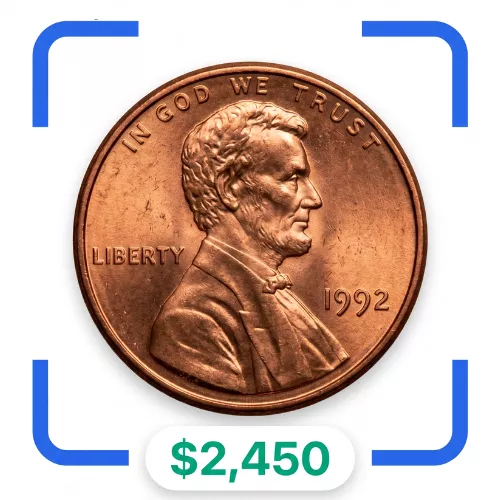


The Philadelphia Mint struck millions of regular Lincoln cents in 1957.
Alongside those standard circulation coins, the mint also produced special proof strikes for collectors.
Proof coins were made using polished blanks and specially treated dies to create a mirror-like finish.
These pieces carry the classic Wheat cent reverse design, featuring two stalks of wheat framing the denomination.
The 1957 proof cent has no mint mark below the date, which indicates it was made in Philadelphia.
While standard proof coins from this year are fairly common, finding one with intense visual contrast is rare.
Coins with heavy frost on the designs and deep mirrors in the background are known as Deep Cameo proofs.
A top-tier example of the 1957 proof penny sold for an astonishing $29,375.
Heritage Auctions handled the sale of this standout piece.
Professional grading services certified the coin in Proof DCAM condition.
The DCAM designation stands for Deep Cameo.
It means the coin exhibits an extreme level of contrast between the raised devices and the flat fields.
Lincoln's portrait and the wheat stalks appear frosty and white, while the surrounding background looks like a dark, polished mirror.
Only coins that meet strict grading standards for both preservation and contrast can reach this level of value.
Most 1957 proof cents trade for modest sums, making this specific auction result truly exceptional.
A Deep Cameo proof from 1957 is hard to find because of how proof dies were prepared in the 1950s.
Mint workers sandblasted the dies to create a frosted texture on the raised parts of the design.
This frost wore away quickly after striking only a small number of coins.
The first few dozen coins struck with fresh dies showed sharp, brilliant contrast.
Subsequent strikes quickly lost that frosty layer and turned into brilliant proofs with no contrast at all.
Because of this fast wear, DCAM contrast on late-series Wheat proofs is scarce.
Thousands of collectors build competitive registry sets and search for the finest known examples of every date.
When an ultra-clean 1957 cent shows true Deep Cameo surfaces, serious collectors compete aggressively to buy it.
That high demand combined with tiny survival numbers drives prices into five-figure territory.
Start by verifying the date on the front of the coin.
Look for the 1957 date on the right side of Lincoln's portrait.
Make sure there is no mint mark under the date, as all proof cents from this era were struck in Philadelphia.
Next, check the finish under good lighting.
A standard business strike made for pocket change has a satiny, luster-filled surface.
A proof coin features smooth, highly reflective fields that act like glass.
To qualify for a Deep Cameo grade, the contrast must be obvious from every angle.
Lincoln's portrait, the lettering, and the wheat ears on the reverse must look thick, chalky, and frosted.
If the portrait is shiny or shows only weak frost, the coin is a standard proof rather than a DCAM.
You can use a 5x or 10x jeweler's loupe to inspect the surfaces for scratches, spots, or signs of wear.
If you want a quick opinion before consulting a professional grader, mobile tools like CoinKnow or Coin Value Checker can help you identify basic coin types.
Keep in mind that raw coins found in old sets or drawers rarely achieve the flawless grade needed to bring record prices.
If you prefer tools over tables, our roundup of the best free coin identifier apps options is the way.
Upload a photo and get an instant value, grade estimate, and error check — no jargon, no sign-up required.