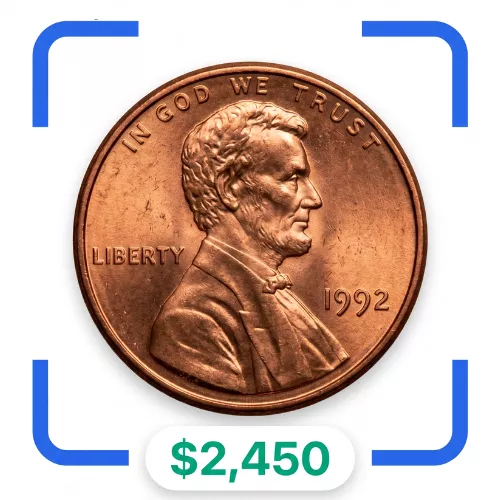


The United States Mint struck this Lincoln cent in 1969 at the Philadelphia facility.
Because it came from Philadelphia, it carries no mint mark beneath the date.
The coin is made of a standard bronze alloy weighing 3.1 grams.
Millions of these pennies went straight into daily circulation during the late 1960s.
Finding an everyday 1969 penny in your pocket change is quite easy.
Finding one that survived without any wear or color loss is an entirely different challenge.
This particular coin represents one of the finest preserved examples known from that production run.
A top-quality 1969 Lincoln cent sold for $5,750 at a public auction.
The sale took place in June 2010 through the auction house Bowers & Merena.
Professional coin graders certified the penny at the grade of MS-67 Red.
The letters MS stand for Mint State, which means the coin never circulated in daily commerce.
A grade of 67 is near perfection on the standard 70-point grading scale.
The Red designation means the coin retains almost all of its original copper brightness.
Collectors compete fiercely for top grades, which pushed the bidding up to that record price.
Most collectors know 1969 for the famous San Francisco doubled die variety.
This Philadelphia coin is not an error or a variety at all.
It is a standard, regular strike penny that simply survived in flawless condition.
Copper reacts quickly with oxygen, moisture, and skin oils over time.
Most 1969 cents turned brown or spotted within a few years of leaving the mint.
Very few pieces escaped bag marks, contact scratches, and surface oxidation.
Because so few reached the grade of MS-67 Red, registry set collectors are willing to pay thousands for one.
The value here comes purely from the condition and the full original color.
You can inspect your own 1969 penny with a few simple steps.
First, check the date on the front right side of the coin to confirm it reads 1969.
Look below the date to make sure there is no mint mark letter.
If you see an S mint mark, you are looking at a San Francisco strike instead of this Philadelphia issue.
Check the surface of the coin under good lighting with a 5x or 10x magnifying glass.
Look for bright orange-red luster across Lincoln's cheek, coat, and the open fields.
There should be no visible contact marks, carbon spots, or dull brown patches anywhere on the metal.
Remember that this is a regular coin, so you should not see any doubled letters or numbers in the design.
If you want a quick opinion before paying for professional grading, use Coin Value Checker or CoinKnow on your phone to scan the coin.
Keep in mind that an ordinary circulated 1969 penny is only worth face value, and only an exceptional certified piece can reach record prices.
For a quick keep-or-spend decision, a closer look at which free coin identifier apps actually works helps.
Upload a photo and get an instant value, grade estimate, and error check — no jargon, no sign-up required.