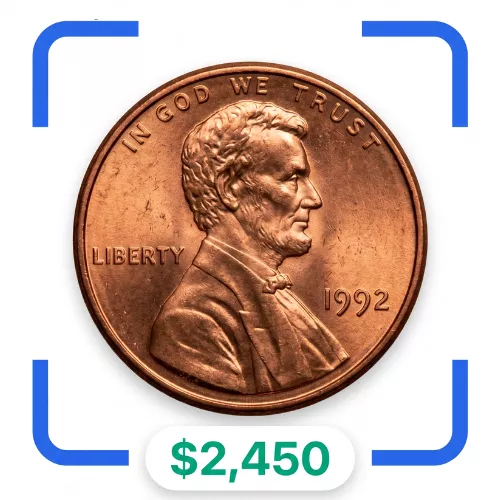


The San Francisco Mint struck special proof Lincoln cents for collectors in 1971.
Proof coins are made with polished dies and blanks to create sharp details.
You can spot these pennies by the small S mint mark right below the date.
Most proof cents from this era have shiny surfaces across the entire design.
A few pieces received a special finish known as Deep Cameo, or DCAM.
This finish gives the raised elements a thick white frost that stands out against dark, mirrored backgrounds.
Deep Cameo examples from 1971 are quite unusual because the mint struggled to keep the frost on the dies.
Only the earliest coins struck from freshly prepared dies received this striking visual contrast.
A top-graded 1971-S DCAM cent sold for an eye-popping $17,250.
Heritage Auctions handled the sale of this standout piece in January 2004.
Professional coin graders certified the penny at an extraordinary PR-69 Deep Cameo grade.
Proof grades use a standard 70-point scale, which means a 69 is just one step away from absolute perfection.
To qualify for this grade, a coin can only have one tiny visual flaw that is hard to see without magnification.
Serious collectors pay huge premiums for certified proof coins that reach the very top of the scale.
A standard proof from that year sells for just a few dollars, but top-tier condition changes everything.
High auction records like this one belong strictly to finest-known certified specimens.
The true driver behind this high price tag is condition rarity mixed with manufacturing limits.
During the early 1970s, the mint did not apply die frosting with consistent modern methods.
The frosted acid treatment on the dies wore off rapidly after striking just a handful of coins.
As the dies wore down, the heavy frosting faded into a brilliant, mirror-like finish.
This means true Deep Cameo survivors from 1971 are genuinely scarce today.
Finding one preserved without copper spots, haze, or handling marks is even harder.
Copper is a delicate metal that easily oxidizes or develops ugly carbon spots over decades.
This PR-69 DCAM penny survived with near-perfect surfaces and exceptional contrast intact.
Collector demand for elite Lincoln cents remains strong, especially for registry set participants who want the finest known examples.
Start by checking the date on the front of your penny to make sure it reads 1971.
Look closely right beneath the date to find the small S mint mark.
Standard pennies struck in Philadelphia have no mint mark, while Denver coins have a D.
Make sure the coin has a proof finish rather than the standard business strike used for pocket change.
Next, tilt the coin under a single direct light source to inspect the surfaces.
A Deep Cameo piece must show heavy, milky frosting on Abraham Lincoln's portrait and the lettering.
The flat fields behind the portrait must look like dark, highly reflective mirrors.
Both sides of the coin need this stark, bold contrast to earn the DCAM designation.
Use a 5x jeweler loupe to check the fields for scratches, fingerprints, or tiny copper spots.
To reach a PR-69 grade, the coin can only show one microscopic imperfection under 5x magnification.
If you are having trouble judging the surface contrast, a mobile scanner like CoinKnow or Coin Value Checker can help you take a first pass.
These apps help you quickly check dates and mint marks before you consider sending a coin to a professional grading service.
Remember that raw coins pulled from old sets rarely grade at this elite level, but discovering strong contrast is always a fun find.
Want to know if it is worth keeping? which free coin identifier apps is worth installing tells you quickly.
Upload a photo and get an instant value, grade estimate, and error check — no jargon, no sign-up required.