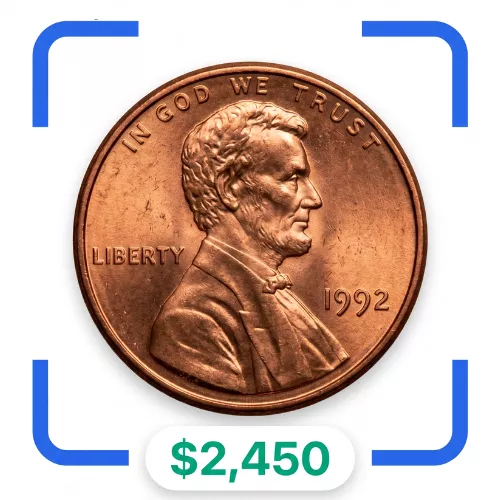


The Philadelphia Mint struck billions of Lincoln cents back in 1973.
Like other pennies from that era, these coins were made from a solid bronze alloy rather than modern zinc.
Because the Philadelphia facility did not use mint marks at the time, these coins have a plain date field under Abraham Lincoln's bust.
Most of the 1973 pennies went straight into everyday pocket change.
Billions of them passed through cash registers, vending machines, and coin jars over the decades.
As a result, finding an average, circulated 1973 penny is very easy and usually only worth face value.
Finding one that survived in untouched, pristine state is an entirely different story.
Coins that kept their fiery copper surfaces without taking on ugly spots or wear are extremely scarce today.
A top-quality 1973 penny made headlines when it crossed the block in an eBay Auction.
The coin sold for an impressive price of $3,960 in a sale that ended in 2/22.
Professional grading services evaluated this specific penny and awarded it an exceptional grade of MS-67.
The MS-67 designation stands for Mint State 67, which represents a nearly flawless uncirculated coin.
To qualify for this grade, a penny must show an extraordinarily sharp strike with virtually no contact marks or hairline scratches.
On top of the high numeric grade, the coin received a full Red color designation.
The Red label proves that at least 95 percent of the coin's original, glowing copper luster remains completely intact.
Collectors compete fiercely for top-tier registry set pieces, which explains why this single sale reached such a high sum.
This 1973 penny is not a hidden mint error or a double die variety.
Its high market value comes purely from its extraordinary condition.
Numismatists refer to this phenomenon as condition rarity.
Copper is an active metal that easily reacts with moisture, sulfur, and air over time.
Most 1973 pennies developed dark brown or reddish-brown tones after only a few years in the wild.
Many pieces also picked up heavy scuffs and bag marks while being shipped in bulk canvas bags from the mint.
The Philadelphia Mint in the early 1970s was focused on high-speed production rather than quality control.
Because of that rapid production, finding an example with crisp details and clean fields is remarkably difficult.
Only a tiny fraction of the original mintage has managed to earn the MS-67 Red grade.
When serious registry collectors want the absolute finest known set of Lincoln cents, they must pay top dollar for coins of this quality.
You can inspect your own 1973 pennies by following a few simple steps under a good light source.
First, check the front of the coin directly below the date of 1973.
If there is no small letter underneath the date, the coin was made in Philadelphia.
Next, you can weigh your coin on a small digital scale to verify its copper metal planchet.
A vintage 1973 bronze penny should weigh approximately 3.1 grams rather than the lighter 2.5 grams of modern zinc pennies.
Take a 5x or 10x jeweler's loupe to inspect the high points of the design for any signs of friction or wear.
Look closely at Lincoln's cheekbone, his jawline, and the fine details in his hair.
Flip the coin over to examine the pillars and roofline of the Lincoln Memorial on the reverse.
Any dullness, flattening, or dark fingerprints will immediately drop the coin down from the elite uncirculated grades.
If you are not sure what you have found, you can scan the piece with CoinKnow or Coin Value Checker for a quick initial assessment.
Always keep in mind that raw pennies pulled from change will almost never match this record price.
Only professionally certified examples in MS-67 Red condition can achieve this level of value in the market.
For a fast estimate straight from a photo, check a closer look at which free coin identifier apps actually works.
Upload a photo and get an instant value, grade estimate, and error check — no jargon, no sign-up required.