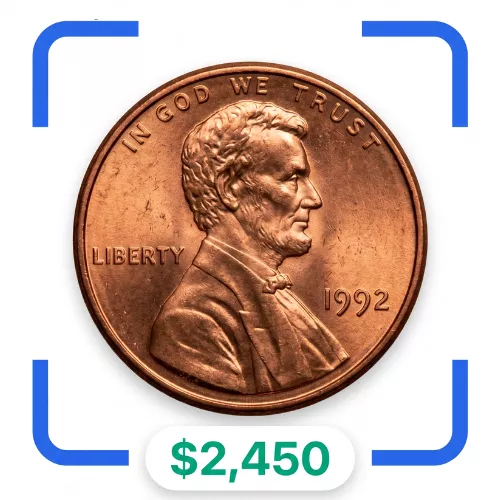


The United States Mint struck this Lincoln Cent in 1974 at the San Francisco facility.
Most modern pennies come from Philadelphia or Denver, but San Francisco also made coins meant for everyday circulation back then.
These pieces are made from a traditional bronze alloy that weighs about 3.1 grams.
Collectors refer to this piece as an RD coin because it still shows full red copper luster across both sides.
Finding a vintage penny that never turned brown or mellowed into red-brown over fifty years is tricky.
Business-strike coins made in San Francisco during this era are much harder to track down in pristine shape than coins from other branch mints.
A top-quality example of this coin sold for $2,703 at Heritage Auctions.
The sale took place during a February 16 auction event.
Professional coin graders certified the penny at Mint State 67 Red, often written as MS-67 RD.
An MS-67 grade means the coin has no major contact marks and keeps its original bright shine.
The surfaces look clean even when you study them closely under good lighting.
Bidders competed hard for this piece because certified gems of this specific issue rarely show up at major sales.
Keep in mind that high auction records belong only to flawless coins sealed in certified holders.
A typical penny from 1974 pulled from pocket change will not bring this kind of money.
San Francisco produced far fewer regular business strikes than the main mints in Philadelphia and Denver.
Most 1974-S cents went straight into circulation where they picked up scratches, fingerprints, and dark brown toning.
Copper reacts quickly with the atmosphere, so finding a coin that kept its original fiery color is uncommon.
This creates what collectors call a condition rarity.
The coin is not rare because of a mistake or an error, but because almost none survived without marks.
Many collectors try to build complete sets of Lincoln cents in MS-67 or better.
When two or more collectors need the exact same date to complete a top-ranking set, the price climbs quickly.
This pressure makes high-end survivors from San Francisco command solid premiums over typical Denver or Philadelphia pieces.
Start by looking directly below the date on the front of the coin for a small S mint mark.
If there is a D or no letter at all, your coin came from Denver or Philadelphia instead.
Next, make sure you have a business-strike coin rather than a proof.
San Francisco also made proof coins for collectors that year, which show mirror-like flat fields and frosted details.
A business strike has a soft, glowing cartwheel shine that spins across the coin as you tilt it under a lamp.
Check the color of the copper under a good desk light.
The coin must show full, unbroken red color across the entire surface with no dark spots or dull brown patches.
Use a 5x or 10x magnifying glass to look for tiny dings, scuffs, or hairline scratches on Lincoln's cheek and coat.
If you are not sure what type of finish you are looking at, you can scan the piece with CoinKnow to get a fast first opinion.
You can also use Coin Value Checker to look up basic details and compare your penny to known varieties.
Remember that raw coins usually grade lower than you think, so handle your coin by the edges to protect the remaining luster.
Want the number now and the reasoning later? See our breakdown of each free coin identifier apps we tried.
Upload a photo and get an instant value, grade estimate, and error check — no jargon, no sign-up required.