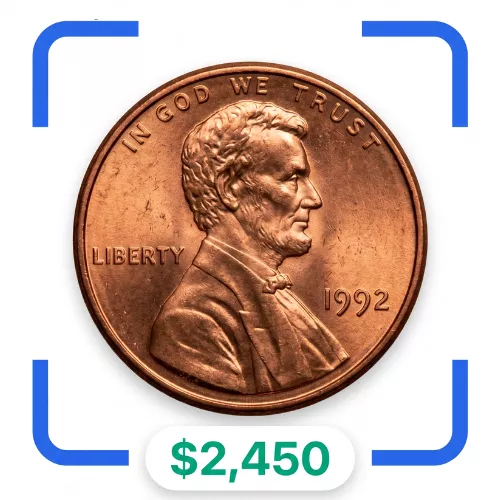


The 1990 No S Deep Cameo Lincoln cent is one of the most famous modern penny errors.
Every year, the San Francisco Mint strikes special proof coins for collectors.
These proof coins feature highly polished dies that create sharp details and mirror-like fields.
Normally, every proof penny made in San Francisco carries a clear "S" mint mark below the date.
In 1990, workers in Philadelphia prepared a proof coin die but forgot to punch the letter "S" into it.
That unstamped die was shipped to San Francisco and used to press thousands of standard proof sets.
Quality control failed to spot the missing letter before the coins were packaged and shipped out.
Only a tiny batch of these error pennies ever made it into public hands.
In August 2007, an extraordinary example of this error crossed the auction block.
The coin firm Bowers & Merena sold this standout piece for a massive $20,700.
The coin was certified in PR-69 condition with a Deep Cameo finish.
On a standard 70-point grading scale, a PR-69 grade means the coin is virtually flawless.
A grader must look under strong magnification to find even the tiniest imperfection on a piece graded PR-69.
The Deep Cameo designation means the coin has deeply frosted design details that contrast boldly against mirrored backgrounds.
Record prices like this are paid only for top-tier certified coins in near-perfect preservation.
A typical circulated coin will never achieve this kind of price tag.
Rarity is the biggest reason this penny commands thousands of dollars.
Experts estimate that only around 200 of these No S proof pennies exist today.
Most of them were discovered inside official 1990 Prestige Proof sets and standard proof sets.
Mint workers caught the mistake after striking a small run, which kept the survival rate extremely low.
Lincoln cent collectors love completing full date-and-mint-mark runs.
When a major variety like this is missing from an advanced collection, serious buyers compete hard to get one.
Modern proof errors of this scale rarely slip past modern Mint security.
That high demand combined with a tiny supply keeps prices very strong whenever one appears for sale.
Spotting this coin requires a careful look at the area right under the date.
Start by checking whether your penny is a regular pocket change coin or a true proof.
A regular business strike 1990 penny made in Philadelphia naturally has no mint mark.
Those common pocket pennies are flat and satin-like, and they are worth only face value.
The rare error coin must be a proof piece with deep, reflective mirror surfaces.
You need to look at the coin under good light with a 10x jeweler loupe.
Inspect the space directly beneath the numbers "1990" on the front.
Make sure the surface is completely smooth and not just worn down or weakly struck.
You can use Coin Value Checker on your phone to run a fast preliminary scan if you are unsure what finish your coin has.
If your penny has mirror fields, frosty raised details, and no trace of an "S", consider sending it to a reputable grading service for authentication.
If you would rather skip the chart entirely, the free coin identifier apps tools we tested side by side handles it from a photo.
Upload a photo and get an instant value, grade estimate, and error check — no jargon, no sign-up required.