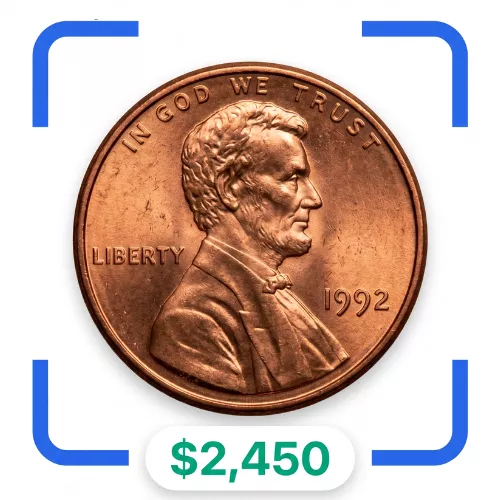


The 1992 Lincoln cent from the Philadelphia Mint is usually just pocket change.
Billions of these zinc pennies entered circulation with full red luster.
A tiny mix-up at the mint created a major rarity that year.
Workers accidentally paired a regular obverse die with a proof-style reverse die.
This created what collectors call the Close AM variety.
It ranks number 5 among the top 200 most valuable pennies.
Finding a true red example from the Philadelphia Mint is extremely tough.
Heritage Auctions sold a stunning example of this coin for $25,850 in January 2017.
Professional coin graders certified the piece at Mint State 67 Red.
An MS-67 grade means the coin looks nearly perfect to the naked eye.
It shows original copper luster without distracting bag marks or ugly spots.
The Red designation means the coin kept at least ninety-five percent of its original mint color.
A price like this comes only from top-tier certified coins sold to serious specialists.
Most coins found in change will not match this level of preservation.
The main driver of value here is an accidental die design change.
In 1992, the mint planned to introduce a new reverse design for proof strikes first.
That proof design placed the letters A and M in AMERICA close together.
The standard design for regular circulation coins kept those letters spaced apart.
A proof reverse die ended up striking regular business coins in Philadelphia by mistake.
Only a handful of these transitional errors exist in high uncirculated grades.
Collectors of modern Lincoln cents compete fiercely whenever one appears on the market.
The mix of extreme scarcity and strong registry set demand keeps prices high.
You can check your own pennies at home with basic magnification.
You will need a ten-power jeweler loupe or a clear magnifying glass.
Flip the coin over to the reverse side and look at the word AMERICA.
Focus on the letters A and M in that word.
On a regular 1992 penny, there is a clear space between the bottoms of the A and the M.
On the rare Close AM variety, the bottoms of the A and M almost touch or touch completely.
You can also look at the designer initials FG near the Lincoln Memorial base.
The initials sit farther away from the building on the rare Close AM reverse.
If you want a quick check before using a loupe, the CoinKnow app can help you examine the design.
Make sure you do not confuse this with the 1992-D version or the later 1998 through 2000 Wide AM varieties.
Always inspect the letters carefully under a bright desk lamp to verify the spacing.
If sorting a collection sounds slow, a closer look at which free coin identifier apps actually works shortens it.
Upload a photo and get an instant value, grade estimate, and error check — no jargon, no sign-up required.