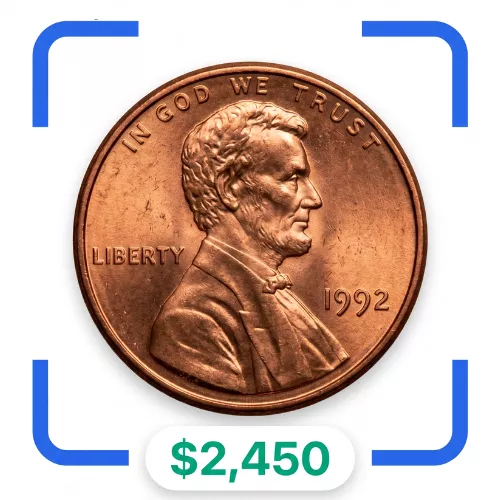


The Philadelphia Mint struck billions of Lincoln cents in 1997.
You can still find them in pocket change without looking very hard.
Like all standard pennies made that year, the core is mostly zinc with a thin layer of pure copper on top.
Because the Philadelphia Mint made them, these coins carry no mint mark beneath the date.
The vast majority of these cents entered circulation and quickly picked up scratches, fingerprints, and dark tarnish.
Finding an everyday 1997 cent is easy, but finding one preserved in top condition is an entirely different challenge.
Among modern zinc pennies, this date holds a special place because of how difficult it is to find without factory flaws.
A single 1997 Lincoln cent made headlines when it sold for $6,360 in an eBay Auction on 2/21.
Professional coin graders certified the piece at a staggering MS-69 Red.
The Mint State scale runs from 60 to 70, meaning a grade of 69 is virtually flawless.
A coin graded MS-69 can only have one tiny microscopic flaw that is nearly invisible without magnification.
The "Red" designation means the coin retains almost all of its original, fiery copper luster from the day the dies struck it.
Collectors who compete for top-ranked registry sets are willing to pay massive sums for these single highest-graded examples.
An auction price like this belongs to an elite certified piece, not a typical coin you pulled out of change.
The immense value of this piece comes down to extreme condition rarity.
Modern zinc cents are mass-produced at blistering speeds by high-tonnage minting presses.
The rapid striking and packaging process usually leaves coins with small contact marks right out of the gate.
Zinc is also a chemically reactive metal that causes problems over time.
If microscopic moisture gets trapped under the copper plating, it forms tiny zinc bubbles or black corrosion spots.
Because of this, the bright copper plating on high-grade specimens must be totally free of spots, milk stains, or plating splits.
Out of the hundreds of millions made, statistical outliers with near-perfect surfaces almost never occur.
Registry set builders constantly search for these near-perfect modern pieces, driving intense bidding wars when one appears.
Start by looking below the date on the front of the coin.
A 1997 cent from Philadelphia will have no letter underneath the year.
You can check the weight on a digital pocket scale to confirm it weighs around 2.5 grams, which confirms the copper-plated zinc core.
If you want a quick starting point, a mobile tool like CoinKnow or Coin Value Checker can scan your penny to help verify its general type and features.
Next, pick up a 5x or 10x jeweler loupe and inspect the surfaces under good lighting.
The coin must show a bright, even red color across both Lincoln's portrait and the Lincoln Memorial on the back.
Look closely for any carbon spots, dark stains, or dull brown toning, as any discoloration immediately disqualifies a coin from top red grades.
Check the wide, flat fields of the coin for any tiny contact marks, hairline scratches, or small zinc plating blisters.
To reach an elite grade like MS-69, the coin must show virtually none of these flaws and look just as sharp as the moment it left the dies.
Want the value without the research? Start with our breakdown of each free coin identifier apps we tried.
Upload a photo and get an instant value, grade estimate, and error check — no jargon, no sign-up required.